6 October 2026
Rethinking Education in the Age of AI
What should remain fundamentally human in education as artificial intelligence becomes part of everyday learning? The final part of our Train-the-Trainer event report turns from individual presentations toward dialogue. The Hungarian-language online session and the Chinese-language online roundtable both created space for broader reflection on AI, teaching formats, student motivation, assessment, lifelong learning and the changing role of educators.
AI as a Support for Meaningful Educational Experience
The Hungarian-language online session was moderated by Dr. Gyöngyvér Márton of Sapientia Hungarian University of Transylvania and Dr. Gergely Tóth of Wekerle International University. The session centred on a single presentation, followed by an extended discussion involving the moderators, the presenter and Rita Horák of the University of Novi Sad.
Prof. Dr. Éva Borsos of the University of Novi Sad, Hungarian Language Teacher Training Faculty, Subotica presented “A tantermen kívüli oktatás a mesterséges intelligencia korában” (“Outdoor Education in the Age of Artificial Intelligence”).
Her presentation examined how AI can support outdoor and nature-based education without replacing its core purpose: direct, sensory and experience-based learning in nature. She argued that AI is most useful in the preparation and evaluation phases, for example when designing differentiated tasks or analysing and visualising data collected during fieldwork, while digital tools should be kept to a minimum during the outdoor activity itself. A key message was that AI should remain a methodological support tool rather than becoming the focus of the learning experience.
The discussion broadened the topic considerably and addressed both the opportunities and the risks of AI in education. Participants reflected on the relatively early stage of AI adoption and on the difficulty of measuring the long-term effects of major educational changes, which may only become visible decades later. At the same time, there was broad recognition that AI is already a powerful and high-impact technology and therefore needs to be used responsibly.
A recurring theme was the importance of regulation and balance. The participants agreed that AI-supported education cannot be completely liberal or unstructured. While gamification and new digital formats can be valuable, teachers still need to work with clear expectations, consistency and academic rigour. The discussion also highlighted that teaching methodologies should be adapted to the needs and habits of the actual learner group, particularly at a time when attracting and maintaining students’ attention has become increasingly difficult.
The changing information environment was also discussed. In addition to family, friends and teachers, social media and influencers now play a significant role in shaping students’ attitudes, interests and knowledge. This means that educators need to understand and respond to the formats students encounter in everyday life rather than relying exclusively on traditional teaching methods.
Assessment was another important topic. Examples from Sapientia Hungarian University of Transylvania illustrated a stronger emphasis on checking students’ own understanding, particularly through final examinations linked to thesis work. The participants discussed the value of viva-style and oral examinations as a way of verifying whether students can explain, defend and apply their own knowledge, especially in an educational environment where AI-generated written work is becoming increasingly easy to produce.
The discussion also emphasized the individual responsibility of teachers for continuous professional development. Educators were encouraged to update curricula, experiment with new teaching methods and follow changing communication trends, including the use of short-form video formats familiar from platforms such as TikTok.
Dr. Gyöngyvér Márton also referred to experiences from China gained during the MedITHub project, where she observed educational short videos being used even in public transport as part of everyday learning. This was discussed as an example of lifelong learning becoming integrated into daily routines. The comparison also led to a broader reflection on digital culture, with the view that digital technologies are used with high confidence across generations in China because educational opportunities are continuously embedded in everyday life.
The session attracted participants from a wide range of institutions and organizations, including the University of Novi Sad and its Hungarian Language Teacher Training Faculty, Sapientia Hungarian University of Transylvania, Wekerle International University, Babeș-Bolyai University, the George Emil Palade University of Medicine, Pharmacy, Science and Technology of Târgu Mureș, primary and secondary schools, private companies and representatives connected to educational administration. This diversity contributed to a discussion that combined university-level, school-level and professional perspectives.
An International Roundtable on the Future of Digital Education
The Chinese-language online roundtable was held via Tencent Meeting and was chaired by Liu Yichen of SLUGU and Wang Hanyi of Wekerle International University. With more than 100 participants joining the meeting, the session was organized as a moderated forum around the main challenges of digital education, including the use of face-to-face, online and blended learning, student motivation, generative AI and the competencies required from educators in a changing digital environment.
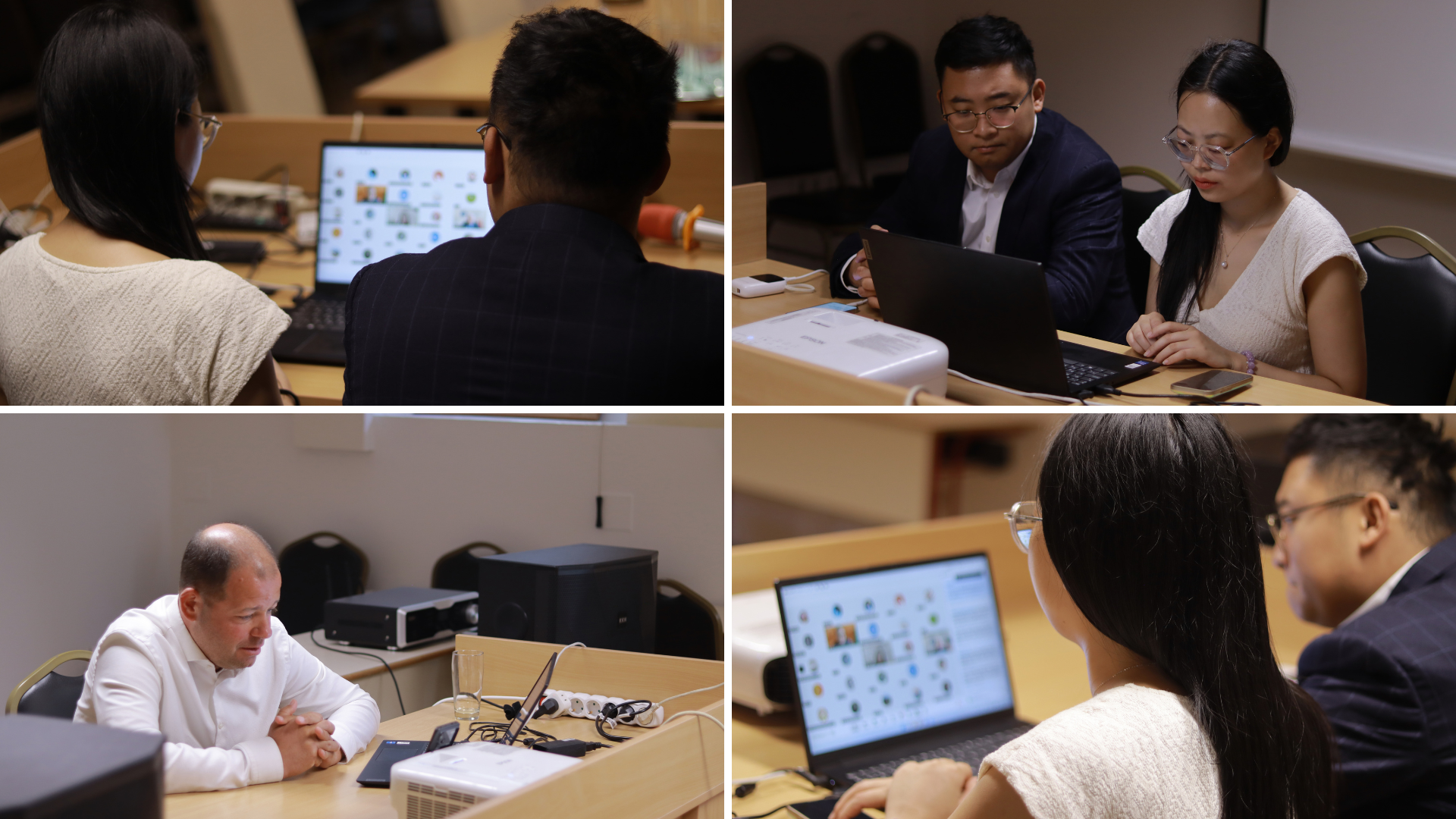
The invited forum guests were Professor Zhou Fei of Shinawatra University; Dr. Zhang Pengfei, PhD in Economics and Rector of “Anania Shirakatsi” University of International Relations, Armenia; Ms. Naomi Yang, AVP of INTI Malaysia; and Professor Lu Jin, Head of Department at the Faculty of Management, University of Armenia.
Given the large number of participants, the roundtable concentrated mainly on the invited forum guests, who were asked to reflect on the key discussion topics rather than following a sequence of formal presentations.
Professor Zhou Fei contributed extensively to the discussion on the relationship between online and face-to-face education. He emphasized that the question should not simply be which format is better, but rather which format best serves the intended educational objective. He distinguished the immediate interaction and personal connection of face-to-face teaching from the flexibility, accessibility and repeatability offered by online education. His contribution therefore moved the discussion toward a more purpose-driven approach to selecting teaching formats.
Dr. Zhang Pengfei contributed to the broader discussion on the challenges of digital transformation and the changing role of educators and institutions. His participation brought a senior institutional perspective to the roundtable, complementing the more classroom- and practice-oriented views of the other guests.
Ms. Naomi Yang contributed to the discussion from the perspective of higher education practice and international education. Her presence added an institutional and learner-oriented viewpoint to the exchange, particularly relevant to questions concerning student participation, digital learning environments and the practical implementation of educational technologies.
Professor Lu Jin also took part in the discussion, contributing to the comparison of online and face-to-face learning and to the broader consideration of how digital tools should support rather than replace meaningful educational interaction. His comments helped reinforce the idea that different teaching formats have different strengths and should be selected according to purpose and context.
Another important part of the discussion concerned student motivation and active participation in digital environments. Participants considered how digital platforms might give students greater choice and responsibility for their own learning, while also acknowledging that technology alone cannot guarantee engagement.
Generative AI also emerged as a topic during the exchange. Questions were raised about how AI should be understood and taught, including the distinction between AI design and AI application. This closely reflected the planned discussion on how generative AI is changing teaching and particularly assessment.
Overall, the roundtable provided a broad and international exchange of perspectives on digital education. A central message emerging from the discussion was that the future of education should not be framed as a choice between online and face-to-face teaching. Instead, institutions should focus on using each format where it adds the greatest educational value, while maintaining student engagement, teacher–student interaction and clear learning objectives.
Despite the very large audience, the roundtable remained centred on a small group of invited experts, allowing the main questions to be explored from several institutional and cultural perspectives.
Bringing the two sessions together provides a fitting conclusion to the Train-the-Trainer event. Both discussions moved beyond the question of whether technology should be used in education and instead focused on how it can be used with purpose. Across different educational and cultural contexts, the conversations returned to the importance of meaningful interaction, student engagement, clear learning objectives, responsible AI use and the continuing development of educators themselves.
The views and opinions expressed are those of the author(s) and do not necessarily reflect those of the European Union or the Tempus Public Foundation. Neither the European Union nor the granting authority can be held responsible for them.